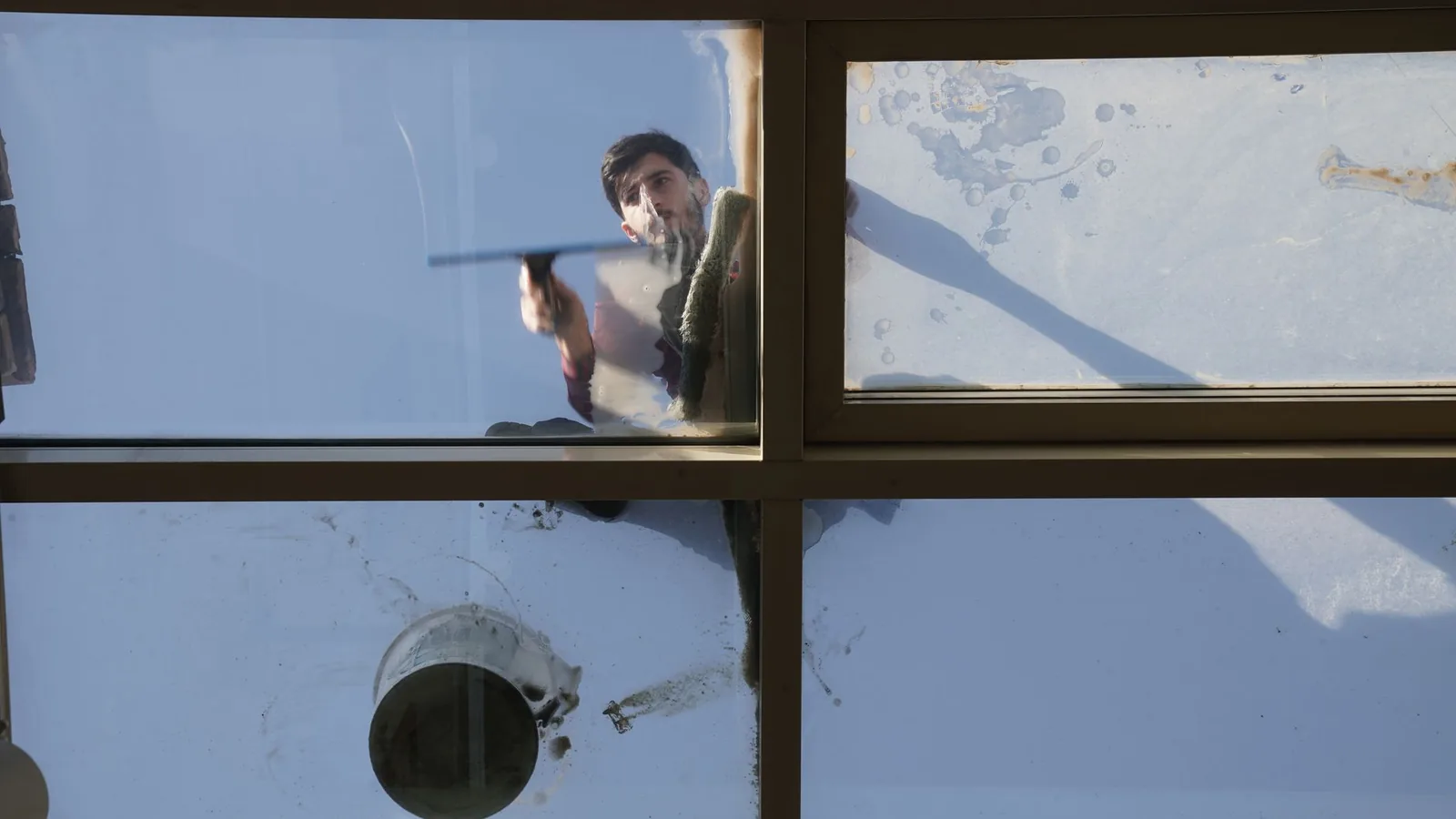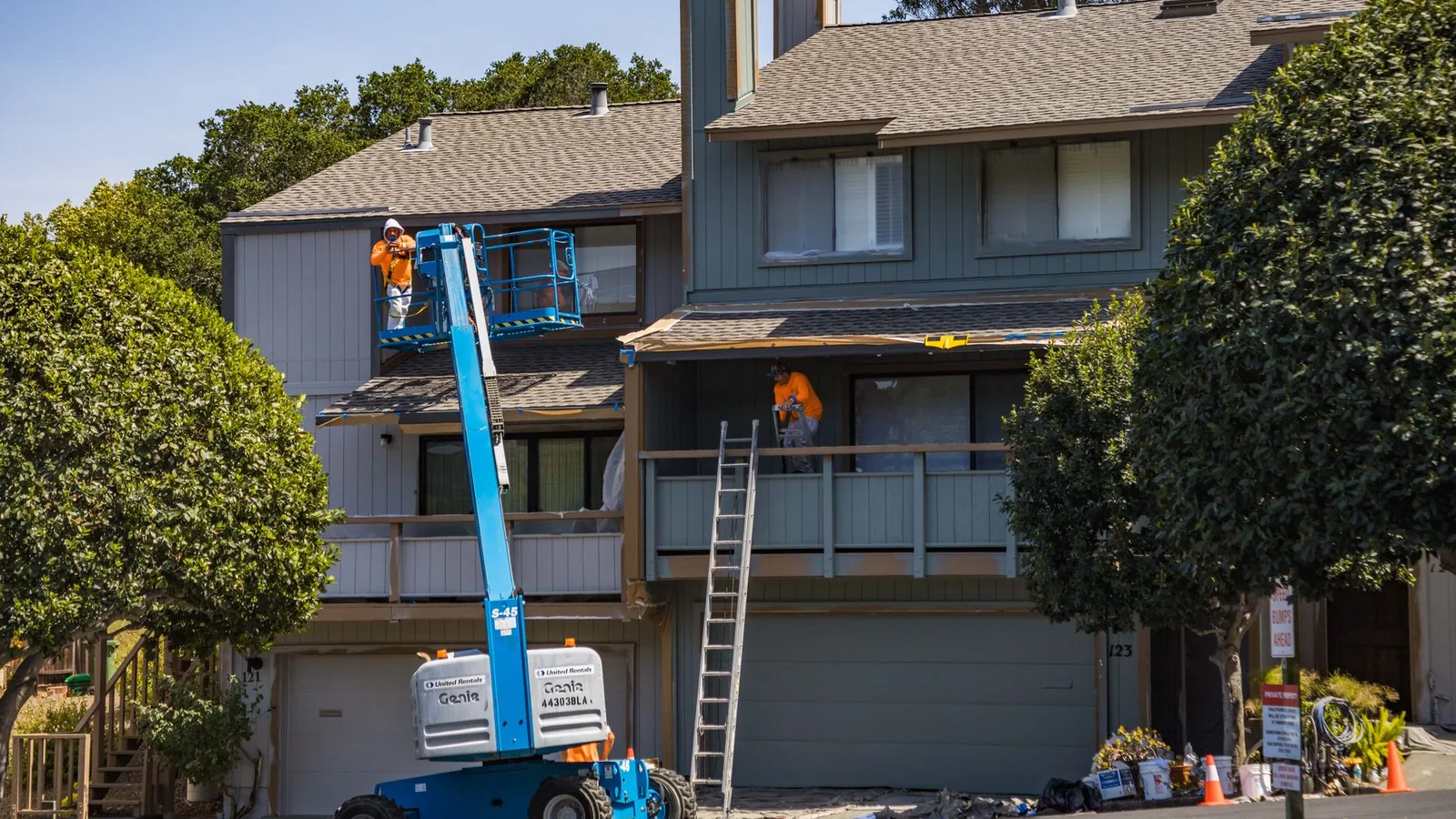
It usually starts on a Saturday morning. The weather's finally good, you look up at the house, and you decide today's the day. You grab a bucket, a squeegee from the hardware store, and you drag the extension ladder out of the garage.
We're not going to lecture you. Plenty of homeowners handle their own ground-floor windows and do a fine job of it. But second-story glass is a genuinely different activity, and it belongs on the short list of home maintenance tasks that put people in the emergency room every year.
Here's specifically what goes wrong — and what professionals do differently.
The core problem: window cleaning needs both hands
Every other ladder task lets you keep one hand on the ladder. Cleaning gutters, hanging lights, changing a bulb — one hand works, one hand holds.
Window cleaning doesn't. You need one hand for the scrubber and one for the squeegee. Both hands are occupied, which means you are balancing, not holding.
Ladder safety guidance universally calls for maintaining three points of contact. Window cleaning structurally violates it. Everything below is a consequence of that single fact.
1. The overreach
This is what actually causes most falls, and it never feels dangerous while you're doing it.
You've got the ladder set. You clean the pane in front of you. There's a corner about eighteen inches to your left. Moving the ladder means climbing down, repositioning, and climbing back up — a three-minute job. Leaning over takes two seconds.
So you lean.
The rule professionals work by: your belt buckle should never pass outside the ladder's side rails. The moment your center of gravity moves outside that footprint, the ladder becomes a lever. The base slides, the feet kick out, and there is no recovery from that position. It takes under a second, and you're falling backward with both hands full and nothing to grab.
2. Water on the rungs
Window cleaning is wet work by definition. Soapy water runs off the glass, down the siding, onto the ladder, and onto the rungs — the same rungs your feet are on.
You're standing on wet, soapy aluminum, fifteen to twenty feet up, holding tools in both hands, wearing sneakers that were not designed for that. Your shoes are also wet, because you carried a bucket up.
Professionals working from ladders use rubber-soled boots, ladder standoffs, and disciplined water control specifically to manage this. A homeowner with a bucket and a hardware-store squeegee has none of that.
3. Wasp and hornet nests
Window frames, eaves, and the corners where trim meets siding are prime nesting real estate — and they're exactly where your face ends up when you're cleaning the top of a second-story window.
You climb, you look up, and you're eighteen inches from an active nest you couldn't see from the ground.
The human startle reflex is involuntary. You jerk backward before your brain has processed anything. On the ground that's harmless. Twenty feet up with both hands full, that reflex is the fall.
Baldfaced hornets in particular defend aggressively and sting repeatedly. If you're allergic and don't know it, you're now having an anaphylactic reaction at the top of a ladder.
4. Uneven, soft, and sloped ground
Setting a ladder correctly requires firm, level footing and the 4-to-1 rule: the base sits one foot out from the wall for every four feet of height. A ladder reaching a second story about sixteen feet up should have its base roughly four feet from the house.
Around a real home, that's often impossible. The spot where the base needs to go is a flower bed, a slope, a mulch bed, a deck edge, or an AC condenser. So the ladder goes too steep — which makes it prone to tipping backward — or too shallow, which makes the base slide out.
Add spring ground that's still soft from snowmelt, and a ladder that felt solid when you climbed can sink and shift under you thirty seconds later.
5. The insurance problem nobody thinks about
This one isn't physical, but it can be the most expensive part.
If you fall off your own ladder, your homeowner's policy may cover medical costs — often with limits, deductibles, and exclusions you've never read. If a friend or neighbor falls helping you, you may be personally liable. If an uninsured handyman you hired off Facebook falls on your property, you may be liable for that too.
A licensed, insured window cleaning company carries general liability insurance and workers' compensation. If something happens on your property, it's covered by their policy, not yours. That's a meaningful part of what you're actually buying — and it's why "the guy down the road will do it for $80" isn't the bargain it looks like. Always ask for a certificate of insurance.
How professionals clean high windows without the risk
Here's the thing that surprises most homeowners: modern professional window cleaning often doesn't involve a ladder at all.
Water-fed pole systems use carbon fiber poles that reach 40 feet or more from the ground, fitted with a brush head and jets that deliver purified, deionized water. The water is run through filtration that strips out every dissolved mineral. Because there's nothing in it, it dries with no spots, no film, and no residue — no squeegee needed, no drying required. The technician stands on the ground the entire time.
It's safer, it's faster, and on high glass it produces a better result than ladder work, because there's no soap film left behind to attract dirt.
When ladder work is genuinely required, professionals use standoffs, levelers, correct angles, proper footwear, and — most importantly — the discipline to climb down and move the ladder instead of leaning.
If you're going to do it anyway
Some of you are going to do this regardless, so here's the honest safety minimum:
- Stick to ground-floor windows. This is the real advice.
- Never climb alone — someone should be home and aware
- Set the ladder on firm, level ground at the 4-to-1 angle
- Use a ladder standoff so the ladder rests on the wall, not the glass or gutter
- Wear dry, rubber-soled boots
- Belt buckle inside the rails, always
- Inspect the eaves and frame from the ground with binoculars first, looking for nests
- Never work on a windy day
- Use a bucket hook so you're not carrying anything while climbing
Stay off the ladder
Clean windows are not worth a broken wrist, a concussion, or a hospital bill that costs more than a decade of professional cleaning.
Dan's Window Cleaning has the water-fed pole systems, purified water equipment, and full liability insurance to clean your second and third-story windows safely from the ground — throughout Bloomfield and the surrounding Upstate New York area.
Put the ladder back in the garage. Let us handle the high stuff.